Ali AzmoudehResearch gallery
ENTERING THE GALLERY
Ali Azmoudeh in a navy blazer and dark sunglasses
PhD Student and Researcher

Ali
Azmoudeh.

I build and evaluate computer vision and multimodal AI, from medical imaging to visual understanding.

Conceptual synthetic facial-expression generation sculpture
02 / HUMAN EXPRESSION

Learning from
synthetic faces.

Investigating the potential—and limits—of synthetic datasets for facial expression recognition.

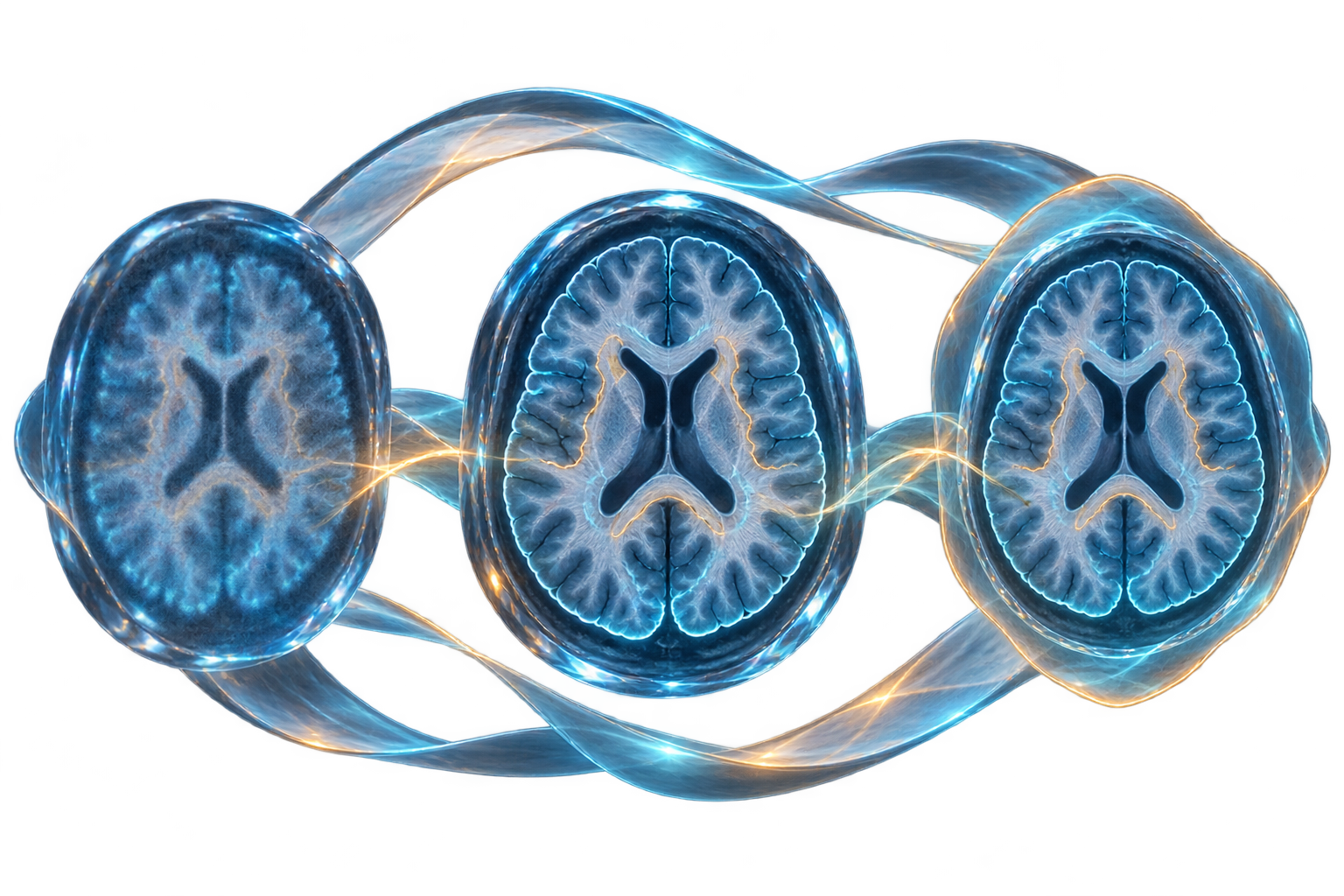
Conceptual MRI image quality and reliability illustration
03 / MEDICAL INTELLIGENCE

Seeing clearly.
Reasoning reliably.

Brain MRI segmentation under domain shift with GLIMS–MedNeXt. Conformal risk control is a separate, ongoing research direction.

Conceptual visual and language inputs connected through a shared attention core
04 / VISION & LANGUAGE

Connecting images.
Understanding meaning.

Multimodal idiom understanding with IMMCAN. Studying how visual grounding and cross-attention connect image and language representations.

Conceptual class-agnostic counting with selected objects and visual query connections
05 / OPEN-WORLD COUNTING

Beyond fixed classes.
Counting what matters.

Our survey examines class-agnostic counting, from visual references to open-world text-guided approaches, and the challenge of generalizing to new objects.

Beyond the gallery / About

A curious mind.
A continuing question.

How can a model generalize responsibly when the real world does not match its training set?

I am a PhD student in Computer Engineering at Istanbul Technical University and a Graduate Research Assistant at SiMiT Lab, working under the supervision of Prof. Dr. Hazım Kemal Ekenel.

My research sits at the intersection of computer vision, deep learning, and trustworthy AI. I study how vision models behave beyond clean benchmarks: under domain shift, limited annotations, low-quality medical scans, privacy constraints, and imbalanced data.

Current directions include reliable brain-tumor MRI segmentation, conformal risk control, vision-language-guided facial expression generation, multimodal idiom understanding, and class-agnostic visual counting.

I enjoy exploring emerging ideas, expanding my knowledge, and applying what I learn to challenging real-world problems.


Research & education

The path
so far.

PhD, Computer Engineering

Istanbul Technical University

Computer vision and trustworthy medical AI

Education

Graduate Research & Teaching Assistant

Istanbul Technical University

Supported by the ITU–Turkcell research scholarship

Experience

Graduate Research Assistant

SiMiT Lab, ITU

Computer vision, biometrics, and medical imaging

Experience

MSc, Computer Engineering

Istanbul Technical University

Education

BSc, Computer Engineering

University of Tabriz

Education

Technical expertise

From questions
to working models.

PythonPyTorchMONAIOpenCVHugging Face TransformersVision-Language ModelsGenerative AICUDAGitLinuxHPC
01 / Model development

Build. Adapt.
Evaluate.

Training and evaluation pipelines for image segmentation, facial expression recognition, and multimodal representation learning. Adapting pretrained models, comparing architectures, and evaluating generalization across datasets.

02 / Experimentation & compute

Research at
every scale.

GPU-based workflows in Python and PyTorch, medical-image processing in MONAI, and experiments on Linux and HPC systems. Analyzing accuracy, segmentation quality, uncertainty, and failure cases.

03 / Language + vision

Different modalities.
Shared meaning.

Pretrained language and vision–language encoders, cross-attention and feature fusion, generative models for synthetic visual data, Hugging Face Transformers, and prompt engineering.

Additional areas of knowledge include large language models and retrieval-augmented generation (RAG), alongside graduate study in NLP, advanced NLP, and generative AI.

Three selected case studies

The work
behind the research.

From the initial question to the experiment, findings, and limitations. Open a project to explore the details.

01Medical imaging · Domain shiftGLIMS-MedNeXtBrain tumor segmentation under domain shift — expand case study

Adapting volumetric segmentation models from high-quality MRI to the imaging conditions represented in BraTS Sub-Saharan Africa.

First author · Model development and experimental evaluation

The question

MRI quality and data availability vary across imaging settings. A model trained on high-quality scans needs evaluation and adaptation before its results can be trusted on a different domain.

My contribution

I developed and evaluated an ensemble of GLIMS and MedNeXt, using transfer learning, SSA fine-tuning, and fusion experiments to study segmentation performance under domain shift.

Methods & tools

GLIMS + MedNeXtTransfer learningEnsemble fusionPyTorchMONAI3D MRI segmentation

Data. BraTS GLI for pretraining → BraTS SSA for adaptation and evaluation; four MRI modalities.

  1. Prepare multimodal MRI inputs
  2. Pretrain and adapt the two segmentation models
  3. Fuse predictions and evaluate segmentation quality
Findings & context

BraTS-Lighthouse 2025 submission

The ensemble work was published in the MICCAI 2025 challenge proceedings in 2026. The paper reports improved accuracy and robustness on BraTS-SSA. See the publication for its full evaluation protocol.

Research evaluation on BraTS data; clinical deployment has not been established. Conformal risk-control experiments are a separate, ongoing research direction.

View the full evaluation ↗
02Synthetic data · Generative AISyntFERLearning facial expressions from synthetic data — expand case study

Building and comparing data-generation strategies for facial expression recognition when labels, class balance, and image-sharing constraints matter.

First author · Synthetic-data research and cross-dataset evaluation

The question

Expression datasets are imbalanced, and collecting or sharing face images raises practical privacy constraints. Can synthetic data improve transfer beyond the training dataset?

My contribution

I investigated three dataset-construction strategies and evaluated their use in facial expression recognition: confidence-based pseudo-labeling, diffusion generation, and GAN expression editing.

Methods & tools

PyTorchIR50POSTERv1Diffusion modelsGAN expression editingPseudo-labeling

Data. RAF-DB, FER2013, and AffectNet for evaluation; DigiFace, DCFace, EmoNet-Face BIG, and FFHQ as data sources.

  1. Construct and balance expression datasets
  2. Train with synthetic-only or mixed data
  3. Measure cross-dataset accuracy and F1
Findings & context

57.02% accuracy on AffectNet

IR50 with Mixed-SYN-C achieved 57.02% accuracy and 56.36% F1 on AffectNet, compared with 40.20% accuracy and 35.82% F1 for the RAF-DB-only baseline (Tables II and IV).

Results depend on the training mixture and target dataset. Synthetic-only training retains a domain gap; these scores are not a universal performance claim.

View the full evaluation ↗
03Vision–language models · Multilingual NLPIMMCANConnecting idioms, captions, and images — expand case study

Ranking five image–caption candidates by how well they express the intended meaning of an idiom in context.

Equal-contribution co-author with Barış Bilen · Multimodal framework development

The question

Literal image matching can miss an idiom’s intended meaning. The task also requires transfer across languages with limited supervision.

My contribution

I co-developed a multimodal cross-attention framework integrating contextual language representations with visual and caption features for idiom understanding.

Methods & tools

XLM-RJina-CLIP-v2Frozen pretrained encodersTwo-stage cross-attentionRanking objectivesCaption augmentation

Data. AdMIRe 1.0 for supervised development; AdMIRe 2.0 for multilingual zero-shot evaluation. MAGPIE supports idiomaticity detection.

  1. Encode the contextual idiom and image–caption candidates
  2. Fuse caption and image features with cross-attention
  3. Condition on the idiom and rank candidates
Findings & context

35.0% zero-shot top-image accuracy

On the AdMIRe 2.0 ALL row, VTT-Cla-Base reached 0.350 accuracy and 0.727 NDCG, versus 0.288 and 0.704 for TT-Cla-Base (Table 3).

The text-only model performed better on the smaller AdMIRe 1.0 test. Caption augmentation had mixed effects. The linked repository currently presents the project overview; implementation availability should be checked there.

View the full evaluation ↗

Selected publications / 2024–2026

Ideas into
contributions.

Peer-reviewed work and open research across medical vision, facial analysis, multimodal reasoning, and visual counting.

P / 012026

On Applicability of Synthetic Datasets for Facial Expression Recognition

Ali Azmoudeh, Erdi Sarıtaş, Ömer Yıldırım, Hazım Kemal Ekenel

2026 IEEE 20th International Conference on Automatic Face and Gesture Recognition (FG) · 2026
Kyoto, Japan · pp. 1–10 · First author

Evaluates pseudo-labeling, diffusion synthesis, and GAN expression editing for facial expression recognition, including how synthetic and real data combine under cross-dataset evaluation.

P / 022026

VisAffect at MWE-2026 AdMIRe 2: IMMCAN Idiom Multimodal Cross-Attention Network

Barış Bilen, Ali Azmoudeh, Hazım Kemal Ekenel, Hatice Köse

Proceedings of the 22nd Workshop on Multiword Expressions (MWE 2026) · 2026
Association for Computational Linguistics · pp. 149–153 · Equal contribution with Barış Bilen

Studies multilingual image ranking using frozen language and vision–language encoders with a trainable cross-attention module. Visual grounding improves zero-shot transfer, while text-only modeling performs better on the smaller in-domain test.

P / 032026

GLIMS-MedNeXt: An Ensemble Framework for Brain MRI Segmentation in Sub-Saharan Africa

Ali Azmoudeh, İlkay Öksüz, Hazım Kemal Ekenel

Segmentation, Classification, and Synthesis for Brain Tumors and Traumatic Brain Injuries · 2026
MICCAI 2025 challenges: BraTS-Lighthouse · LNCS 16376 · Springer, 2026 · pp. 262–273 · First author

Combines GLIMS and MedNeXt with pretraining, fine-tuning, and ensemble fusion for brain-tumor segmentation in lower-quality MRI.

P / 042026

A Survey on Class-Agnostic Counting: Advancements from Reference-Based to Open-World Text-Guided Approaches

Luca Ciampi, Ali Azmoudeh, Elif Ecem Akbaba, Erdi Sarıtaş, Ziya Ata Yazıcı, Hazım Kemal Ekenel, Giuseppe Amato, Fabrizio Falchi

Computer Vision and Image Understanding · 2026
Volume 267 · Article 104703

Organizes 29 counting approaches into reference-based, reference-less, and open-world text-guided methods, comparing performance and generalization on FSC-147 and CARPK.

P / 052024

Advanced Facial Expression Classification with CNN-Transformer Integration for Human-Computer Interaction

Ali Azmoudeh, Çiğdem Altın Gümüşsoy, Hazım Kemal Ekenel

2024 9th International Conference on Computer Science and Engineering (UBMK) · 2024
Antalya, Türkiye · pp. 800–805 · First author

Applies facial detection, landmark and feature extraction, and CNN–Transformer classification to examine expression responses during online shopping tasks.

Research collaboration

Let’s build vision
systems that generalize.

For research discussions, collaborations, or questions about my published work, reach me through my ITU email.

azmoudeh22@itu.edu.tr
SCROLL TO MOVE THROUGH THE GALLERY ↓01 / 05